
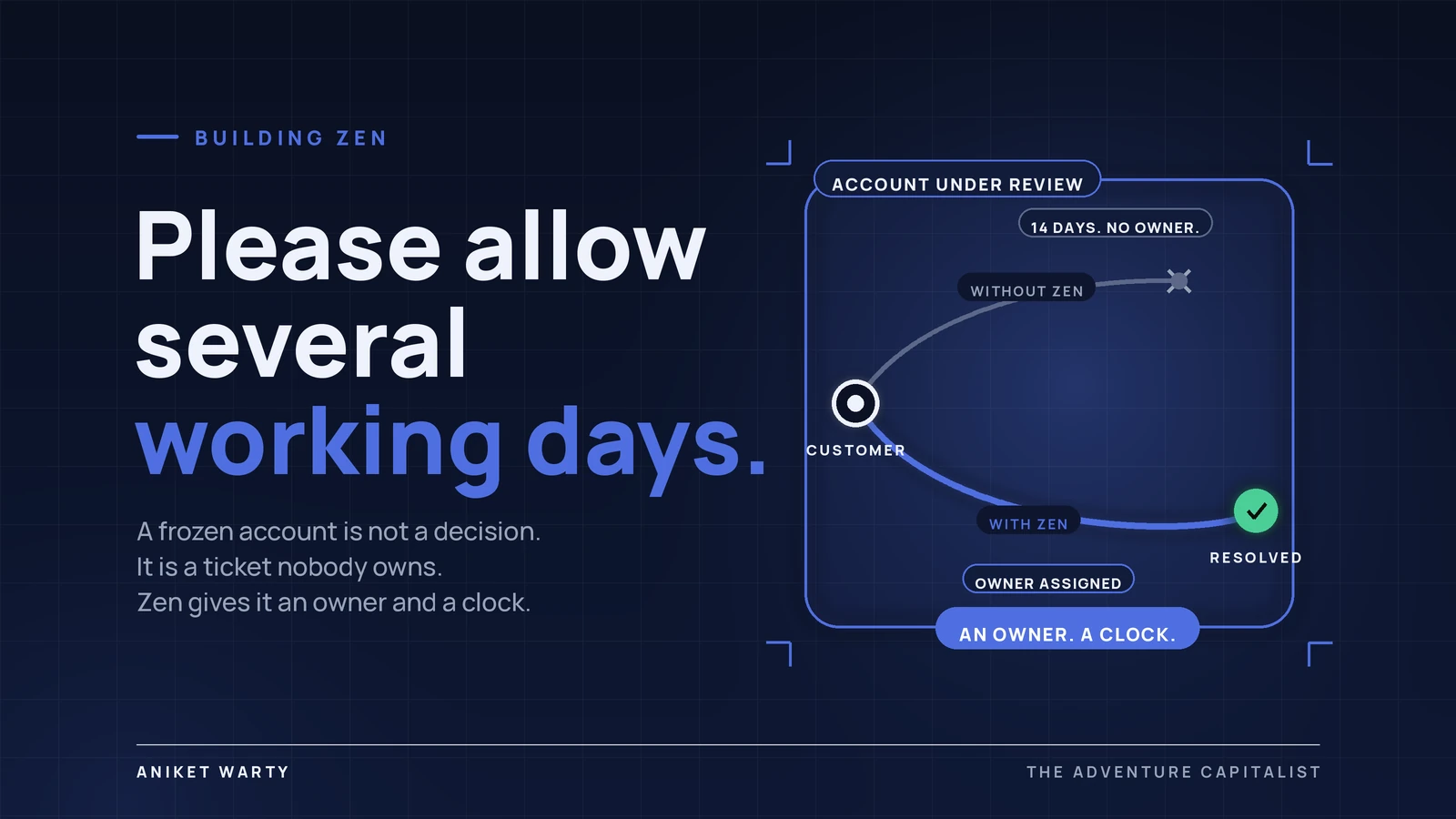
A bank can interrupt your life without ever raising its voice.
One blocked transfer. An account frozen. A message saying that your relationship is under review. You have salaries to pay, a supplier waiting, perhaps a hospital bill. Somewhere inside the institution, your situation has become a ticket. The person answering the telephone cannot explain the decision, cannot reverse it and cannot tell you when anyone who can do either will look at it.
Please allow several working days.
The bank continues working. You get to explain to everyone else why you cannot.
Compliance Is Not An Excuse
I find the moral arrogance of this arrangement extraordinary. A person earns money by producing something another person wants. He then places it within a financial institution under agreed terms. Somehow, the practical relationship can deteriorate into one where he must plead for access while the institution offers almost no account of its own performance.
Treating that indifference as an operating policy is an abuse of power. Calling the department responsible “compliance” does not improve it.
Why This Is A Commercial Opportunity
I want Zen to power banks because correcting this failure is a commercial opportunity. Banks possess distribution, capital, established relationships and regulated capabilities. Zen can develop the systems that help those capabilities serve customers properly. I intend to earn from that work. Better banking ought to be profitable for the people who make it better.
But first, the industry needs to hear something plainly: a banking licence does not certify competence, and control over an account does not confer moral ownership of the customer’s life.
A Private Dictatorship Over One Account
Imagine a business owner whose account receives an unusually large payment after completing a contract. The payment merits examination. Fair enough. Now suppose the bank restricts the entire account, requests documents already submitted and leaves the owner chasing different departments for an answer. Friday’s payroll arrives before the answer does.
Friday arrives whether the review is finished or not. Employees expect their salaries. The supplier expects payment. The owner could lose a contract while the bank congratulates itself on having requested another document. Who is measuring that cost? A completed checklist tells us very little about the business left waiting.
At its worst, this creates a small private dictatorship around a person’s financial affairs. One side can immobilise the other; the injured party must petition the same organisation for relief. Its mistakes acquire force. Your objections acquire a reference number.
To a customer paying for a service and then denied meaningful access to it, the experience can feel remarkably like a scam. The marketing promises a dependable financial relationship. The reality delivers unilateral power, obscure conditions and a help desk equipped chiefly to say that it cannot help.
The $225 Million Fraud Filter
There are documented failures behind this criticism.
In July 2022, American regulators imposed $225 million in combined penalties on Bank of America over its handling of unemployment benefits. The Consumer Financial Protection Bureau found that a faulty automated fraud filter had unlawfully frozen accounts, harming thousands of legitimate recipients. People spent hours on hold over weeks, and the bank redirected customers to an overwhelmed state agency. These were funds intended to help people survive the pandemic. [1]
Read that again without the marketing. An institution entrusted with delivering money used a defective process to prevent legitimate recipients from accessing it, then made obtaining help extraordinarily difficult.
Automation made the failure larger. Institutional authority made it harder to escape.
Aggressive Is Not The Same As Competent
There is another uncomfortable part of this picture. Aggressive restrictions do not prove that a bank understands financial crime. An institution can inconvenience legitimate customers while maintaining inadequate controls over risk.
In October 2024, Britain’s Financial Conduct Authority fined Starling Bank nearly £29 million for financial crime control failures. Its automated screening had checked customers against only a fraction of the sanctions list. It also opened more than 54,000 accounts for high-risk customers despite an agreed restriction on doing so. High-risk customers are not automatically criminals; the finding concerned the bank’s failure to honour its controls and obligations. [2]
An app can be beautifully designed and the operation behind it still be badly run. Put that on the next innovation panel.
“Computer Says No” Is Not A Policy
I take fraud seriously. A criminal trying to steal a customer’s money should encounter effective barriers. Sanctions obligations, court orders and genuine investigations can require restrictions. Certain information cannot lawfully be disclosed. Any serious financial business has to deal with these realities, including ours.
The question is whether the institution does the work competently. What justified the intervention? How broadly does it need to apply? Who investigates? What evidence would resolve the concern? Who checks whether the restriction remains necessary? A lawful obligation should produce disciplined action, with a responsible person attached to it.
In its November 2023 review of twelve account providers, challenger banks and payment firms, the FCA identified weaknesses including poorly resourced teams, slow complaints and customers passed between departments. It urged firms to consider better onboarding and monitoring to reduce freezes, swifter investigations to shorten them, and better communication within legal limits. These are practical expectations from a regulator, not fantasies about banking without rules. [3]
I would add a management question: who inside the bank pays attention when its own precaution becomes the customer’s emergency?
An account restriction should enter a process that has an owner and a clock. Where the law and the evidence permit a narrower intervention, the institution should examine that option. Cases need escalation when they age. People need updates that tell them something useful. A person in acute difficulty deserves an actual route to someone authorised to assess the situation.
“Computer says no” is a description of defective management. Computers do what institutions design, permit and fail to correct.
A banking licence does not certify competence, and control over an account does not confer moral ownership of the customer’s life.
Where My Interest Becomes Commercial
This is where my interest becomes commercial.
I have no objection to banks earning money. I want them to earn plenty by performing a service customers deliberately choose. I object when an institution treats its privileged position as permission to stop earning that choice. Confidence built over decades can be consumed by a few weeks of contemptuous service.
A bank that wants to improve already has something valuable: customers who trust it enough to place their financial lives within its systems. It may have a merchant base, a treasury business, lending relationships and access to local payment networks. Building every new capability internally requires time, specialised knowledge and operational work. A capable infrastructure partner can make that investment more productive.
That is the opportunity I see for Zen.
Why I Start In The UAE
The UAE is a sensible place to begin this conversation. I live and build here, and the proposition can be tested against specific institutions and their customers. A bank serving a trading company has a different requirement from an exchange house handling individual remittances. We should understand the actual demand, establish which services the partner is authorised to provide and build an offer around those facts. I would much rather discuss a customer’s recurring payment problem with someone who owns the business than sit through another presentation about the future of finance.
Take a bank serving exporters. Its customers receive payments from abroad, convert currencies, pay suppliers and need records that reconcile with their invoices. Some want approved access to digital assets or stablecoin settlement. The bank should be able to assess that demand and offer a properly structured service, with clear prices and responsibility for the money at each stage.
Zen’s proposition is to help that institution assemble and operate the necessary capabilities. The customer could use the bank’s own interface and brand. Underneath, the services would have to connect identity checks, payment instructions, conversion, execution and reconciliation. Each component needs a defined job. Each handover needs evidence that the job was done.
The Stack Underneath The Bank’s Brand
ZenTrust has a place here because somebody needs to establish who the customer is and who is authorised to act for him. For a company, that means understanding the business, its ownership and the people giving instructions. The evidence should reach those who need it, subject to appropriate access and privacy controls. Asking the customer to explain his company afresh to every department is an expensive way to advertise that your systems do not talk.
ZenPays gives us the basis for connecting the payment workflow. An instruction comes in; somebody must know whether it was accepted, where it went, what settled and what happens if it fails. The merchant should be able to reconcile it against his invoice. He has a business to run. Investigating the bank’s conflicting records should not become his second occupation.
Wallet and card capabilities can extend that service where the programme, permissions and jurisdictions support them. A merchant who receives money may then need to hold it, convert part of it or spend it. ZenTokenize adds another potential institutional offering, provided the asset, holder’s rights and legal structure justify it. A token is no excuse to become careless about ownership.
Atlas is the routing and settlement system we intend to build into this architecture. Until it is ready, offers must rest on existing capabilities and contracted providers that we can demonstrate. I will not sell a roadmap as though it were a functioning service. A bank purchasing infrastructure should insist on that distinction.
Nor will routing become a trick for evading a lawful restriction. An alternative provider can help when an approved route is unavailable or commercially unsuitable. It cannot turn a prohibited transaction into an acceptable one. The permission to move money has to survive every stage of the journey.
The institution retains its applicable responsibilities. Supplying software does not transfer a bank’s duties to a convenient name on an invoice. The contracts must establish the regulated roles, custody arrangements, decision authority and responsibility for complaints. Customers need to understand whom they are dealing with. The bank needs the means to supervise what it has bought.
I want a relationship where those facts are clear before anybody starts announcing a partnership.
A Bank’s Right To Choose Its Customers
A bank has its own rights in this relationship. I defend its freedom to choose the lawful business it wants to pursue, within its contractual and legal obligations. Voluntary exchange requires willing parties. If a relationship must end, the institution should handle that exit competently, communicate what it lawfully can and return funds when permitted. A customer should have a practical means of taking his business elsewhere. Keeping someone trapped in an unresolved process while declaring that he is unwelcome makes a mockery of choice. The same principle applies to Zen: we must earn continued use, and our customers must be able to exercise the rights their agreement gives them. Freedom works in both directions, or the bargain has already gone wrong.
What An Ordinary Working Day Should Look Like
The changes I care about are visible in an ordinary working day. A business submits an instruction and sees the price before accepting it. The system checks authority and eligibility. The payment proceeds over an approved route. Its status remains visible. If something requires review, the right team receives the relevant evidence and a task someone actually owns.
Compare that with a customer discovering a problem through a failed payment and then becoming the unpaid messenger between departments. Better infrastructure should remove that labour from his day.
It should also make bad decisions easier to find. I want records showing which rule triggered a review, which information was considered and who authorised the next action. Where appropriate, a second person should approve a consequential restriction. An institution needs to distinguish a genuine risk signal from a recurring defect in its own process.
Artificial intelligence can assist with that work. It can help identify patterns, organise evidence and direct attention. Giving a model the ability to produce a confident explanation does not establish that its conclusion is sound. Someone must remain accountable for deciding what happens to a customer’s money, and the system must support correction when the decision is wrong.
For the bank, this has an economic case beyond pleasant customer feedback. Staff spend time chasing missing records, revisiting incomplete cases and handling complaints that earlier competence could have prevented. Customers abandon products they cannot trust. An institution capable of seeing and correcting those costs has a reason to purchase better systems.
What Zen Charges For, And Why
Zen has to make money from this too. Implementation involves work that must be priced. A continuing service has continuing costs. Every charge needs a reason that survives examination. I expect the bank to question our fees as hard as I question a vendor’s. If we cannot explain what a charge buys and why it is worth the price, we have a problem to solve before issuing the invoice.
Prove It With One Bank First
I would begin with one institution, one defined customer group and a limited set of approved uses. Perhaps exporters with a particular collection and payout requirement. Prove the full journey with real transactions. Test the uncomfortable parts, including delayed settlement, rejected instructions, complaints and exit. Let the results determine the next investment.
The measurements should include the customer’s experience of a failure. How quickly did someone competent take ownership? How long did an unnecessary restriction remain? Could the customer get an intelligible update? Did the final record reconcile? A dashboard showing successful transactions tells part of the story. The awkward cases reveal what the operation is made of.
Here is the part no software vendor can fix for the bank. If its managers regard every complaint as an irritation and every delay as somebody else’s problem, better technology will simply help them behave badly at greater speed. The chief executive must be willing to examine the damage his institution causes. A licence does not relieve him of judgment.
The Same Standard Applies To Us
I will also apply the standard to Zen. Our products will encounter mistakes, disputed transactions and customers who deserve a better answer than the first one they receive. We will have to investigate and correct those failures. My criticism of banks obliges us to take our own performance seriously.
That obligation fits the reason I build businesses. I believe in voluntary exchange between people pursuing their own interests. The customer brings money and a requirement. The provider brings competence and accepts agreed responsibilities. Each earns what he receives. A large institution remains subject to that principle however impressive its headquarters looks.
Money represents choices made possible by productive effort. Blocking access to it can interfere with a person’s ability to honour contracts and pursue the life he has earned. An institution exercising that power owes rigorous attention to the grounds, scope and consequences of its decision. Casual indifference is morally indefensible.
I want Zen to power banks that see the opportunity in doing this properly. Their customers already need better services. Their businesses can earn more by providing them. We can earn by supplying capabilities that deserve to be bought.
That is a commercial ambition I am entirely comfortable owning.
The bank does not acquire a claim over the customer’s life because it holds his account. The customer’s productive effort is what brought the money into his hands. Our job is to make the agreed financial service work.
Every fee, every restriction and every piece of infrastructure should be judged against that fact.