
Put Anthony Hopkins in the wilderness with a bear hunting him, and I am interested. Give him a useful fact, the nerve to think while frightened and a plan he must personally carry out, and I am watching closely.
The bear has no interest in his character development. This is refreshing.
In The Edge, Hopkins plays Charles Morse, a wealthy man whose reading becomes useful under conditions considerably less comfortable than those in which he acquired the knowledge. The pleasure of watching him comes from seeing a mind go to work. He has to understand the problem, choose a response and stake his life on it.
That is the sort of hero I want more often.
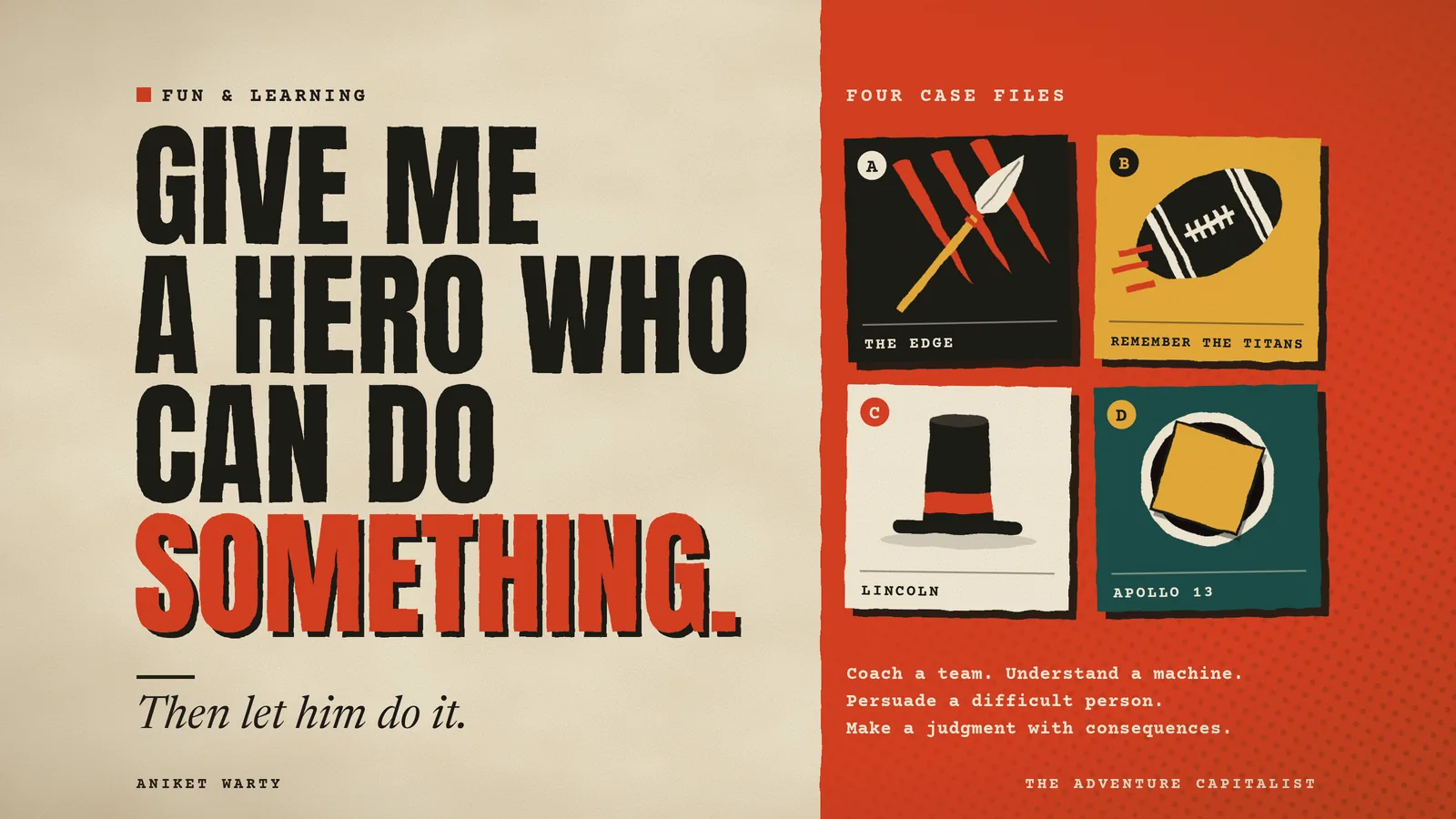
I enjoy watching somebody who can do something. Coach a team. Understand a machine. Persuade a difficult person. Make a judgment with consequences. There is a particular satisfaction in seeing a character meet reality with the equipment required to handle it, especially when that equipment includes a functioning brain.
A story can give me danger, grief, uncertainty and an appalling situation. I do not require the protagonist to spend most of it being useless. Nor do I need a supporting cast whose intelligence has been temporarily confiscated so the leading man can appear impressive.
Denzel Washington in Remember the Titans. Anthony Hopkins in The Edge. Daniel Day-Lewis in Lincoln. These performances give authority a visible basis. Their characters have work to do, and the work tells us who they are.
It is a pleasure. That matters too. We are allowed to enjoy excellence without first submitting an explanation of how it benefits everybody else.
A plan with teeth
The bear confrontation in The Edge gives the argument a wonderfully unforgiving setting.
Morse and Bob, played by Alec Baldwin, have been reduced to the problem of staying alive. Morse proposes using spears and the bear’s own weight against it. The men prepare a trap and improvised weapons. The confrontation becomes a struggle in which preparation helps, but does not make the outcome tidy. The suspended trap initially misses. They still have to fight, and the bear ultimately falls onto Morse’s spear.[1]
There is a plan. There is also a bear.
We understand why the plan might work. That makes watching it go wrong considerably more alarming.
What grips me is the connection between thought and action. Knowledge has acquired a job. The audience can understand enough of the intention to recognise what the men are attempting, while the danger remains entirely capable of ruining the attempt.
Part of the pleasure is being allowed to follow. We know what the preparation is for, so an object in the frame becomes more than scenery. We begin to anticipate the attempt. The suspense sharpens because we understand something of what failure would mean. Withhold every useful detail and I can only wait for the film to announce that something exciting has happened. Give me a reason to watch a particular movement, and I participate. I can hope for the right thing to happen before it happens. When it does, the relief has a shape. It belongs to a difficulty I have understood.
Morse’s intelligence would be a tedious ornament if it existed only to let him win arguments. Here, it changes what the characters can attempt. That gives the intelligence dramatic weight. We are watching the difference a thought makes.
Hopkins gives the character a seriousness that helps us accept this. Morse is no swaggering outdoorsman performing for an appreciative audience. The danger reaches him. His mind has to function in the presence of fear, which is a considerably more interesting achievement than looking fearless in flattering lighting.
I like that the film allows a rich man to possess more than money. His reading belongs to him. So does his curiosity. Wealth has not somehow disqualified him from being resourceful, although certain stories seem deeply offended by the possibility.
A library is no guarantee of judgment, of course. Plenty of people can repeat something they have read. The difficult part is deciding whether it applies, understanding its limits and accepting the consequences of using it. A character becomes compelling when that work becomes visible.
The scene also gives confidence a cause. We can see what supports the decision. That makes confidence easier to admire than the familiar cinematic arrangement in which a man speaks loudly and the universe obligingly proves him right.
Preparation does not abolish uncertainty. It gives the character something to do with it.
Once the confrontation begins, Morse cannot insist that events follow the sequence he imagined. He has to remain useful when they do not. Hopkins makes that effort worth watching. I am interested in whether the man can do it, rather than waiting for the film to congratulate him.
The coach between the speeches
Remember the Titans contains speeches. Very good speeches, delivered by Denzel Washington, which is already an unfair advantage over most people with a microphone.
The Gettysburg sequence is memorable. But I am equally interested in what Herman Boone does when the film gets down to the daily business of making a team.
At training camp, he tests what the players actually know about teammates of another race. Louie Lastik can answer; others cannot. Boone requires the boys to spend time learning about one another’s families and personal interests, and to report back. They must keep doing it. He makes their refusal to cooperate carry a practical cost in additional training.[2]
That is a concrete intervention. It deals with an observable problem.
He could announce that prejudice is bad and leave the boys to organise themselves exactly as before. Instead, he changes what they have to do during the day. Their ignorance of one another becomes harder to preserve. They have to encounter a particular person where they had been content with a category.
The distinction matters because a team cannot function through approved sentiments alone. Players need to understand and trust the people whose decisions affect their own performance. Saying the right thing about unity does not complete a block.
Washington makes Boone’s demands feel attached to an objective. There is a game to play and a standard to meet. His authority carries the weight of someone who expects his instructions to become behaviour.
There is also a quieter moment with Lastik, who assumes college is beyond him. Boone asks to review his test scores with him each week. The attention becomes particular. Here is a young man with a problem, and the coach proposes work they can undertake.[2]
I find that more persuasive than a general declaration that he cares about his players.
None of this requires endorsing every coaching method the film depicts. Authority can become excessive to ensure a win sometimes. A useful demand needs a reason, and shouting does supply one. What I admire is Boone’s capacity to identify something that is preventing progress and take responsibility for addressing it.
His players have responsibilities too. Their effort counts. So does their ability to change. The story would lose much of its pleasure if Boone’s excellence required everyone else to remain an idiot until he rescued them from themselves.
A capable leader makes the competence of others matter. Watching that happen is just as satisfying as watching a room defer its judgment to the most competent person in it.
Lincoln has a vote to win
Political competence presents a harder case. A bear cannot be persuaded. A legislator can, although the process may occasionally make the bear seem preferable company.
Daniel Day-Lewis’s Lincoln lives in a world of other people’s motives. Conviction has to operate through disagreements, ambitions, fears and the awkward fact that the President does not cast everybody else’s vote.
One revealing scene concerns George Yeaman, who is resistant to the proposed amendment abolishing slavery. Lincoln has read the man’s speech. In their private conversation, he listens to Yeaman’s fears about emancipation, addresses them and brings him back to the particular decision before him. The film later gives Yeaman an affirmative vote.[3]
The specificity is the pleasure. Lincoln is dealing with this man’s objections to this decision. He has bothered to understand the resistance instead of treating it as an invitation to deliver his standard address.
This is a dramatised exchange, not a transcript of a private historical meeting. I am interested here in the character the film creates and the performance that makes his thought convincing.
Day-Lewis allows Lincoln to feel occupied by the person in front of him. A story, a pause or an argument can become an instrument of judgment. The familiar public figure becomes a man trying to accomplish something in a particular room.
That makes him more interesting to me than a monument brought indoors for the convenience of the camera.
The goal has moral weight. Abolishing slavery means ending a claim of ownership over human beings. The political task is to turn that judgment into a result that survives beyond the speaker’s conviction. A principle deserves someone capable of understanding the work required to put it into effect.
But success cannot settle every question about the methods used. The film’s wider campaign includes patronage, pressure and bargaining. Those choices deserve scrutiny. Admiring Lincoln’s purpose does not require handing every tactic a certificate of innocence.
That tension makes the film worth discussing. A serious hero has to judge means as well as ends. If we permit a desirable outcome to excuse anything done in its name, competence merely gives wrongdoing a more effective operator.
The Yeaman scene offers something more attractive: preparation, attention and persuasion directed at a consequential choice. Lincoln has done enough thinking to know what he needs. He then does the personal work of trying to obtain it.
Speech belongs in that work. There is no sensible objection to a character speaking well. My objection begins when the speech substitutes for everything that ought to give it substance.
Let the character say something important. Then show me what he understands, what he decides and what follows.
The performance has work to do as well
These are actors making fictional people convincing. That distinction is easy to forget when a performance is exceptionally good.
Hopkins does not need to make us believe Anthony Hopkins could personally execute every wilderness manoeuvre. He needs to make Morse’s knowledge, fear and determination belong to the same person. Washington has to make Boone’s instructions feel connected to a coach’s purpose. Day-Lewis has to let a political argument emerge from a mind rather than arrive as a polished quotation.
I enjoy performances that make me forget to keep score of the acting. Washington can fill a room, and Hopkins can make a confrontation ferocious. Day-Lewis gives language tremendous force. But I remain interested in Boone’s players, Morse’s survival and Lincoln’s vote. The actor has made the character’s immediate concern mine.
There is a difference, and audiences do not need a degree in film studies to feel it.
It also explains why a scene can remain enjoyable after we know the outcome. The surprise has gone, but the quality of the attempt is still there. We can watch how an argument develops, how a person responds and how the performance carries us through that response. A familiar piece of music does not become worthless because we remember the ending. Neither does a well acted scene. Excellence offers more than information about what happens next.
An actor can suggest that a character is listening by making the next response belong to what he has heard. He can suggest expertise by treating the work as something familiar, while allowing the difficulty of this particular situation to remain. He can give a choice weight without stopping the film to label it significant.
The camera and the writing have responsibilities here too. Give me enough of the task to follow the judgment. Let a discovery precede the decision it changes. Allow an action to produce a consequence I can recognise.
I do not need a technical manual. I need the story to honour its own causes.
If the character is supposed to be an excellent surgeon, teacher or investigator, let his excellence appear in the work. Let me see enough of the work to judge that reputation.
Preparation does not abolish uncertainty. It gives the character something to do with it.
Let other people be good at their jobs
Apollo 13 offers another pleasure: competence distributed across several people. Tom Hanks’s Jim Lovell can be a compelling centre without turning Mission Control into decorative furniture.
The carbon dioxide filter problem gives the film a beautifully definite task. The available equipment does not fit the required arrangement. People on the ground devise an adaptation using materials the astronauts have aboard, then communicate it so the crew can reproduce it. NASA’s account of the real improvised device confirms the underlying problem and solution.[4]
Watching the reasoning travel from one person to another is part of the excitement. An explanation becomes something somebody else can build. The achievement belongs to people doing different jobs well enough for the work to connect.
That does not diminish the hero. It makes the world around him worth inhabiting.
An excellent pilot should benefit from an excellent engineer. A coach should have players capable of applying what they learn. A politician should meet someone whose objection requires a serious answer. Otherwise, the protagonist is competing in a championship organised entirely for his convenience.
I prefer excellence that survives the presence of other excellent people.
There is more dramatic possibility in that arrangement too. Capable people can disagree because they understand different parts of a problem. Their disagreement has content. They can change their minds for reasons the audience has been allowed to follow.
Compare that with the character who rejects an obvious solution solely because the screenplay needs another twenty minutes. I can forgive a mistake. I am less patient when the plot has ordered a temporary shutdown of the brain.
Ability alone does not make a hero
A capable person can pursue a rotten objective. That should be obvious, but admiration for skill can blur the distinction surprisingly quickly.
The efficient fraudster remains a fraudster. Someone who understands people may use that understanding to deceive them. An expert can lend his abilities to cruelty. None of this becomes admirable because the execution is impressive.
For a hero to stay with me, the purpose has to matter as well as the ability. I want to understand what he values, why he chooses it and what he is prepared to do or refuse in pursuing it.
Morse’s desire to live needs no apology. Boone’s players have something worth achieving together. Lincoln’s struggle concerns people whose lives should never have belonged to somebody else. These purposes give the competence a direction I can admire.
The character does not have to be flawless. An infallible person produces very little suspense and rather a lot of suspicion. Give him incomplete information. Let an error cost him. Show whether he can recognise the error and recover.
I want his emotions to belong to the work as well. Fear can make a decision harder. Affection can give an achievement its importance. Anger can reveal that a standard has been violated, while also tempting him to misjudge the response. A capable character has plenty of room for an inner life. Watching him bear the pressure can be moving precisely because we believe he understands it. He knows what might be lost. His effort therefore has a personal weight that a generic display of distress cannot supply. He need not explain all of this aloud. An actor can let us recognise the cost in the choice itself.
His limits can reveal his judgment. Knowing when to ask another person, when to wait or when to abandon an attractive idea is part of being capable. Refusing to learn can make a gifted character dangerous to everyone relying on him.
Nor must every achievement require a noble death. I am perfectly happy for a capable person to succeed and enjoy the result. Survival, a game well played or a difficult job completed can be satisfying ends. Happiness is allowed into the cinema without arriving disguised as a sacrifice.
What stays with me is the sense of a person exercising ownership over his choices. The circumstances may be brutal. His control may be limited. Within that limit, he thinks and acts. He gives the story a human cause.
These are people I enjoy spending a film with. They notice things, understand more than they announce and make choices I want to follow. Their ability gives me something to admire. Their predicament gives me a reason to keep watching.
Give me danger if the story needs it. Give me difficult choices and consequences that cannot be waved away. Give the actor something to understand and the character something worth doing.
Then let him do it.
Sources
- The Edge American Humane production account of the bear sequence
The Edge film dialogue including Morse’s spear plan - Remember the Titans film dialogue including camp and Lastik scenes
Remember the Titans original production notes and filmmaker interviews - Lincoln Tony Kushner screenplay Yeaman meeting and vote
- NASA Apollo 13 carbon dioxide filter adaptation